

April 16, 2026
Peoples Fund, Nobody fails at 5Cs, and Encampment Support Network, hosted a mutual aid teach-in at the Motley on Feb. 25 to encourage students to get more involved and to redistribute their wealth towards marginalized communities.
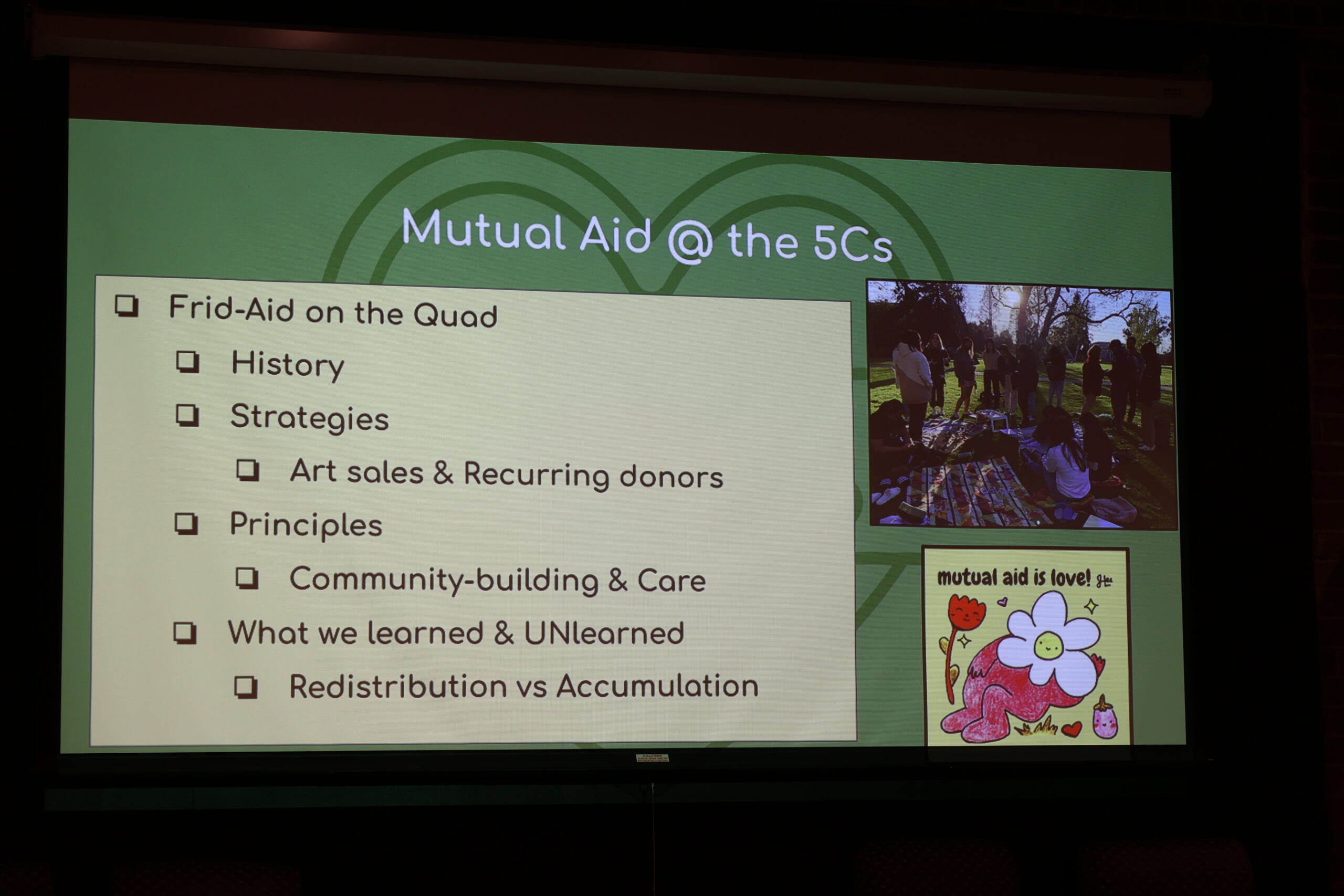
On Feb. 25, 60+ people gathered at the Motley to learn about the history of mutual aid at the 5Cs, and how to get more involved. The teach-in aimed to spread awareness of the mutual aid networks at Claremont and encouraged new members of the community to participate.
The event was co-hosted by People’s Fund, Nobody Fails at Scripps (NFAS), and Encampment Support Network (ESN), all student organisations that aim to foster inclusive spaces for political education and organizing at the 5Cs. Student speakers gave presentations about the history of mutual aid, both nationwide and on campus, then members of each organization spoke up to introduce their history, their goals on campus, and how new attendees can contribute.
7C AAPPA created a charcuterie board, and Glassroots served mocktails throughout the event. All proceeds from the drinks were donated to the People’s Fund and redistributed to families impacted by ICE. After the teach-in, students enjoyed drinks at the mixer and mingled amongst organizers, sharing stories about their experiences with different mutual aid organizations across campus.
The Theory and History of Mutual Aid
The teach-in began with an explanation of what sets mutual aid apart from charities, while also pointing towards the historical movements and organizations that set the foundation of mutual aid.
A member of People’s Fund and ESN distinguished mutual aid from liberal charity models that strip recipients of aid of their autonomy by positioning them as victims and passive actors. In contrast to this, mutual aid aims to meet basic needs and treats community care as a necessity for survival amidst a collective struggle.
Additionally, organizations in the nonprofit industrial complex are monitored by state and corporate entities, meaning there is a shift to hire educated workers into “helping” positions, rather than supporting organizing initiatives led by the everyday person. This forced professionalization of mutual aid overshadows the political struggle in the community organizing support space.
The ESN member quoted Dean Spade, author of Mutual Aid: Building Solidarity During This Crisis (and the Next), to explain how mutual aid rejects blaming the individual.
“The idea that those giving aid need to ‘fix’ people who are in need is based on the false notion that people’s poverty and marginalization are not a systemic problem but caused by their own shortcomings,” said the ESN speaker.
Speakers then described the history of mutual aid and community organizing by using examples of the Black Panther Party (BPP) and the Young Lords Organization. Founded in 1966, BPP was a black power organization that advocated for class struggle and aimed to change society through social revolution. In total, the Black Panther Party created 65 ‘survival programs’ with the slogan “Survival pending revolution”, including their free breakfast program, which fed 20,000 children daily.
The Young Lords, a group of working-class and marginalized Puerto Ricans in New York City, sought out material change in their community by creating a free health clinic, day care, and breakfast programs.
“Mutual aid doesn’t always take the form of money,” said a speaker who organizes in both People’s Fund and ESN. “It can be food, clothes, childcare, free healthcare, transportation, and other forms of labor to help other people in your life.”
Mutual Aid at Claremont
The next speaker, a member of the People’s Fund, shared the long history of student-led mutual aid at the Claremont Colleges by detailing their own experience learning about what mutual aid looks like. it.
Frid-aid on the Quad was a collective led by students who already had prior experience with a mutual aid organization: the founding members sold arts and crafts in their local community, and brought this model of mutual aid to Claremont. Thus, the weekly tradition of selling art on Marston Quad every Friday was born.
Beyond raising money, Frid-aid on the Quad was significant to the 5C community because it encouraged students and community members to become regular donors. Students who were originally one-time donors joined Frid-aid by fulfilling other community needs and other personalized requests, such as driving people without access to cars to places.
The speaker also explained how, within the 5Cs, there is a wide spectrum of wealth, so those who have money are encouraged to distribute it.
“This is all premised on this understanding that not everyone here has access to the same level of wealth, but that no matter what, there are ways to live by mutual aid principles and go in the mutual aid organizing community,” they said.
The speaker described how Frid-aid on the Quad changed their perspective of wealth and security.
“It really challenged me to kind of reconsider the scarcity mindset and endless desire for accumulation,” said the speaker, explaining how they grew up being told to save up and keep their money invested. “A lot of us have internalized this belief that security lies in storing and growing our wealth. [But] if I wanted to [question] businesses and collegiate institutions’ drive for profit and accumulation, I also needed to confront that logic within myself.”
The speaker has since pledged to set aside a portion of their earnings from their art to mutual aid every month, in recognition of the beginning of their engagement with Frid-aid on the Quad.
The People’s Fund
The People’s Fund was created in response to a lack of pro-Palestine organizing on campus that redistributed money to Palestinians and other people in the Global South.
The group’s mission is to redistribute wealth to countries facing oppression from the Global North, with the belief that material and monetary support is integral to collective liberation. Historically, their efforts have focused on gathering aid for Sudan, Congo and Palestine.
“People do not have enough food to eat due to the Zionist embargo. And though food is starting to trickle in, it’s still at exorbitant prices,” a speaker for People’s Fund said regarding the Zionist entity’s continued genocide of the Palestinian people.
Sudan and Congo are similarly affected by the Global North’s imperialism. “[Sudan] is experiencing one of the worst proxy wars of the 21st century, and millions of West Darfuris and minority groups are caught in the crosshairs,” said the representative.
They also highlighted how all batteries in modern technology come from Congo, and how the people of Congo are displaced, exploited and oppressed for the Western world’s sake.
“We cannot organize without acknowledging this [exploitation] and returning our wealth to the right stewards of the land, whether that be the indigenous people on occupied land right here, or abroad,” they said.
Beyond these three counties, another member highlighted how the People’s Fund was now becoming involved with Myanmar, which is currently going through the longest-running civil war in modern history. In light of the mass exodus and ethnic cleansing of minorities in Myanmar, the People’s Fund has mobilized and planned an upcoming teach-in on Myanmar near the end of April.
Nobody fails at 5Cs (NFA5C)
Nobody Fails at 5Cs was created to help students struggling during the COVID-19 pandemic. In the spring of 2020, the group advocated for the Universal Pass policy, which allows all students to opt for pass/fail for classes — hence the original name of the organization, Nobody Fails at Scripps.
Since the Universal Pass campaign, leaders of NFA5C shifted towards campaigning for mutual aid fundraising in order to materially support students in need. Through a community aid pantry located in Motley, NFA5C supplies free masks, informational resources, and other necessary supplies, free and available to all students.
In total, Nobody Fails at 5Cs has raised over $200,000 for mutual aid, largely to aid students still suffering from the effects of the pandemic. The goal of this fundraising is to redistribute the wealth on campus to the surrounding communities. The collective responds to requests from students and alumni, and platforms monetary requests for support.
“Aid is effort, solidarity, and helping our communities is the best action we can take to also help ourselves,” said a representative of NFA5C, a senior at Scripps. “As we know, our institutions aren’t gonna prioritize what communities [need for] help because it’s not profitable, but we’re going to keep providing that stuff.”
NFA5C urged underclassmen to get involved in any capacity, noting that most current members are seniors.
Encampment Support Network (ESN)
The Encampment Support Network is a mutual aid collective that distributes essential items such as food, water, first aid, hygiene products, harm reduction items, menstrual care, and weather protection to unhoused neighbours every week.
As a majority of unhoused neighbours are black, Latinx, disabled, and elderly, ESN recognizes the importance of offering solidarity and protection to our local marginalized community. ESN also provides help to people escaping domestic violence, LGBTQ youth, food-insecure neighbours, and sex workers.
“While we are supporting these people, we also build long-term relationships by listening to what they say and respecting their boundaries,” a member said of the relationships ESN strives to build with unhoused neighbors.
The member explained that the organization aims to teach that being unhoused is a process of capitalist displacement enforced by structural violence, which is a systemic issue with no relationship to an individual’s life choices. Therefore, ESN rejects the nonprofit industrial complex and denounces related requirements such as police cooperation and bureaucratic barriers.
“Our intention is to form solidarity that supports autonomy, safety, and well-being,” a member from ESN concluded.


Abolition
Abolition
Labor

Undercurrents reports on labor, Palestine liberation, prison abolition and other community organizing at and around the Claremont Colleges.
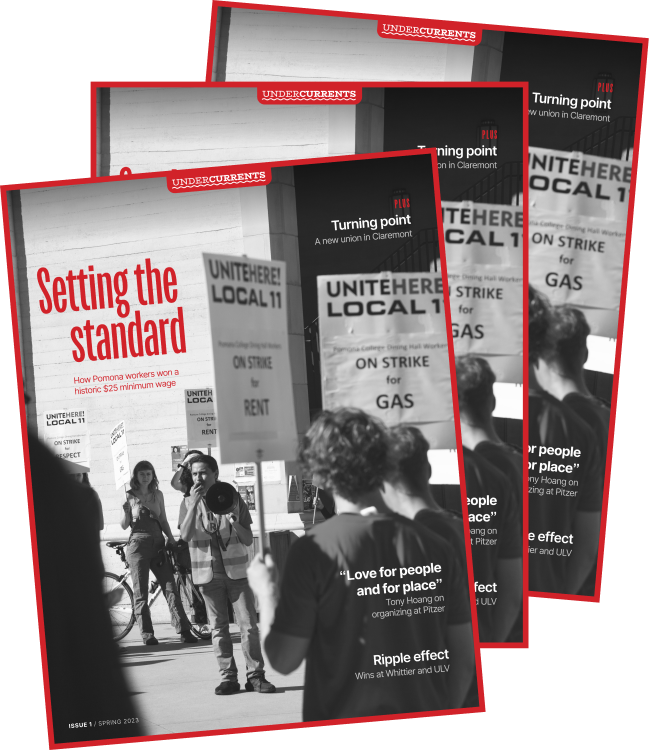
Issue 1 / Spring 2023
Setting the Standard
How Pomona workers won a historic $25 minimum wage; a new union in Claremont; Tony Hoang on organizing
Read issue 1